 Call Us Now
 Email Us Now
Bradenton Slip and Fall Attorneys
After a slip and fall in Bradenton, you can recover from your injuries when a property owner’s negligence caused them, and we can help you prove it. Most slip and fall cases in Florida don’t turn on whether you actually fell, though. They turn on one word: knowledge.
Florida Statute 768.0755 requires an injured person to prove that the business knew, or reasonably should have known, about the hazard before the fall happened. Simply falling on a wet floor rarely proves enough on its own, which is why so many claims stall before they start.
A fall accident attorney Bradenton FL clients hire needs to build the knowledge argument from day one, not after the insurance company has already denied the claim.
Manatee County sees a specific mix of these cases, shaped by grocery chains along US-41, restaurants near the Riverwalk, and retail centers drawing residents and winter visitors, and the venue often decides the outcome.
Not sure whether your fall meets the standard?
Call our Bradenton office at 941-748-5599 for a free case evaluation.
Why These Cases Are Harder to Win Than People Expect
The law separates two kinds of knowledge. Actual knowledge means an employee saw the hazard, or another customer reported it, and staff failed to act.
Constructive knowledge is different. It means the hazard existed long enough that a reasonably careful business should have caught it during a routine inspection, or that the same hazard kept happening in the same spot.
Proving either type usually comes down to timing. A puddle that sat for two hours looks very different in a lawsuit than one that formed thirty seconds before you walked through it.
Consider a common scenario. A shopper slips on melted ice near a self-service drink station. If footage shows the ice had been forming for forty minutes with employees walking past it twice, that’s constructive knowledge. If a customer spilled a drink seconds earlier and no one saw it, proving the case gets much harder.
Where These Falls Happen Around Bradenton
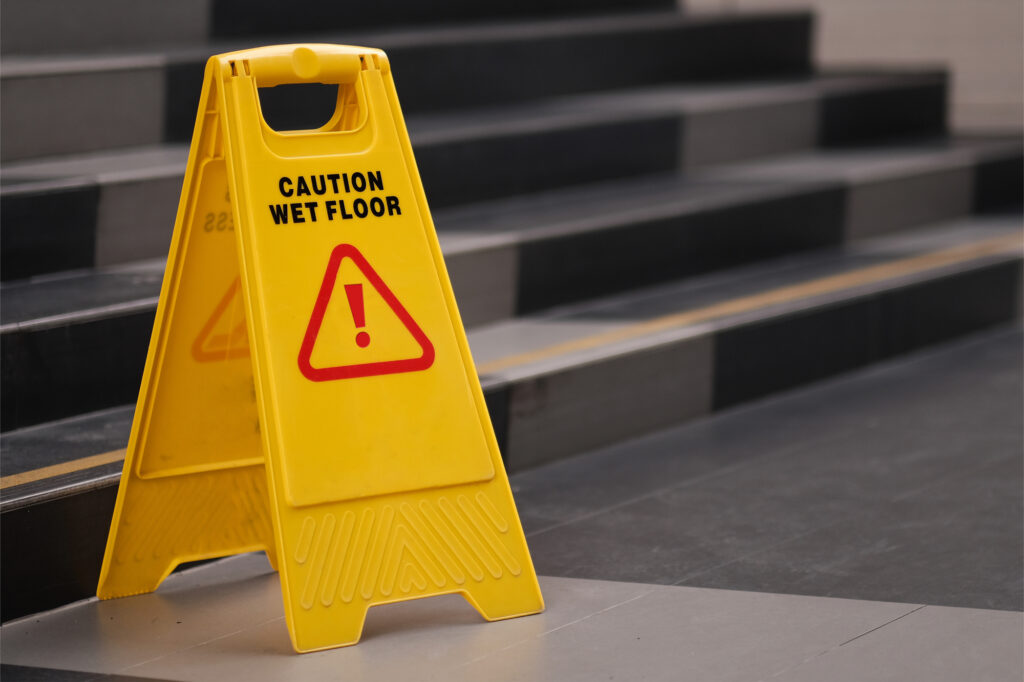
Grocery stores along US-41 and Cortez Road generate a steady share of our slip and fall caseload, usually tied to produce section spills, leaking freezer cases, or wet entryways during Florida’s frequent afternoon rain.
Some chains maintain detailed sweep logs documenting every floor inspection, while others keep inconsistent or incomplete records. That difference alone can shape how strong a constructive knowledge argument turns out to be.
Restaurants near the Bradenton Riverwalk and along Manatee Avenue see a different pattern, often connected to kitchen spills that reach the dining area or bathroom floors left wet after cleaning.
DeSoto Square Mall and the retail centers near Ellenton bring their own risks, particularly around food court seating areas and entrances during the winter tourist season, when foot traffic multiplies fast and spills go unnoticed longer between staff checks.
Parking lots deserve their own mention. Potholes, cracked pavement, and poor lighting near big-box stores off 53rd Avenue cause falls that have nothing to do with spills at all, and those cases follow a different legal standard than a wet floor claim.
Movie theaters and medical office buildings around Bradenton add another category entirely. Dark theater aisles and cluttered waiting rooms create hazards that are easy to overlook until someone actually gets hurt badly enough to need real medical care, and these venues often carry less rigorous inspection routines than a major grocery chain typically does.
Community pools and clubhouse areas in Bradenton’s many gated developments generate a smaller but steady caseload, too, usually involving wet pool decks or uneven pavers around a shared amenity space that residents use daily.
Homeowners’ associations sometimes assume their maintenance contractor bears full responsibility, but the association can still share liability if it knew about a recurring hazard and failed to correct it within a reasonable time.
The 50 Percent Rule Changed the Stakes
Florida’s recent tort reform replaced the old pure comparative negligence system with a modified version. Under Florida Statute 768.81, a person found more than 50 percent at fault for their own fall recovers nothing.
Insurance adjusters know this, and they use it. A common defense is arguing that the hazard was open and obvious, meaning any reasonable person would have seen and avoided it.
Another common tactic blames distraction, claiming you were looking down at your phone instead of watching the floor. A slip and fall injury attorney Bradenton residents trust knows how to counter both arguments before they take hold in the insurance file.
Adjusters often request a recorded statement within days of the fall, sometimes before you’ve even seen a doctor. Questions in that call are frequently designed to get you to agree that the hazard was visible or that you weren’t paying close attention, both of which get used later to push blame back onto you.
Before you give any recorded statement, know that the adjuster’s questions are built to shift blame onto you. Call our Bradenton office at 941-748-5599 for a free case evaluation first, and let us handle the insurer while you focus on recovering.
Apartment and Condo Falls: What HB 837 Did and Didn’t Change
A fall at an apartment complex, on a broken stairwell, an unlit walkway, or cracked common-area pavement generally follows the same premises rules as any other fall: the owner is responsible for hazards it knew or should have known about and failed to fix.
HB 837 created a presumption against liability for multifamily properties that adopt certain security measures, but that presumption applies to injuries caused by a third party’s crime on the property, such as an assault in a poorly secured common area, not to an ordinary fall caused by poor maintenance.
The distinction matters most when a case involves both, for example, a fall during or right after a crime in a dim, unsecured stairwell. Sorting out which framework governs, and whether the security presumption is even in play, is exactly the analysis a case like this needs early.
The Injuries That Follow These Falls

Hip fracture claims often involve extended treatment and a long recovery, which weighs heavily in older clients’ cases. Wrist and shoulder injury claims are common, since people instinctively reach out to break a fall, and their full cost is not always clear at the outset.
The injuries a fall leaves behind largely determine what a claim is worth, because they drive the medical costs, lost income, and long-term needs at the center of any recovery. The most serious cases we see also tend to be the most contested by insurers.
Head injury claims deserve particular attention because their effects are not always visible right away, which is one reason prompt medical documentation matters so much to the claim.
Back and spinal injury claims round out the most common category, and soft-tissue claims in particular can be harder to value early because the damage does not always appear on imaging. That is exactly why consistent medical follow-up matters: it builds the documented record a credible claim depends on.
Stairwells and Other Overlooked Hazards
Falls on stairs and in poorly maintained common areas can be just as actionable as a wet-floor case, and often turn on a building-code violation rather than a spill. Broken or uneven stair treads, missing handrails, and inadequate lighting in stairwells cause a meaningful share of the falls we see, particularly in older commercial buildings downtown.
Building codes set minimum standards for stair rise, tread depth, and handrail height, and a violation of those codes can serve as strong evidence of negligence independent of the actual or constructive knowledge standard.
A building-code specialist who inspects the stairwell after the fact can measure these dimensions and compare them against the applicable building code edition in effect when the property was built or last renovated, often a stronger argument than eyewitness testimony alone.
The Evidence That Actually Wins These Cases
Security footage disappears fast. Many businesses overwrite camera systems within one to two weeks, which means requesting preservation of footage needs to happen immediately, not after weeks of medical treatment.
Sweep logs and inspection records matter just as much. A business without a documented cleaning schedule has a harder time arguing it exercised reasonable care, and a sloppy or missing log can become key evidence in your favor.
Witness statements taken the same day carry more weight than those taken months later. Memories fade, and a witness who saw the spill sit there for twenty minutes is far more useful right after the incident.
Photographs matter more than most people realize. A clear picture of the hazard, taken before anyone cleans it up, often does more to establish the case than a written description ever could, especially with a timestamp and a wider shot of the surrounding area.
Why Local Court Experience Matters Here
Most Bradenton slip and fall lawsuits move through the Manatee County Courthouse on Manatee Avenue West, part of the Twelfth Judicial Circuit. Our office has appeared there regularly since 1989.
That history means we know which judges expect early motion practice and which insurance defense firms typically litigate hard rather than settle quickly. A slip and fall attorney Bradenton clients choose without that background is negotiating blind.
Every case at our firm stays with one attorney from the first phone call through resolution. We prepare each file as though it’s headed to trial, because insurance companies negotiate differently once they know a firm will actually litigate.
Nearly a century of combined courtroom experience across our attorneys means the defense firms that regularly appear in Manatee County already know our approach, and that reputation shapes settlement offers long before a lawsuit is ever filed.
Frequently Asked Questions
Get it if you can, but don’t panic if you can’t. Businesses are generally required to keep an incident report on file, and a lawyer can request it through a formal preservation letter before it goes missing.
Ask in writing and follow up quickly. Some stores claim there’s no footage simply because no one checked before the system auto-deleted it, and a preservation letter sent early can force them to look before that happens.
Yes, though it helps your case. Florida law doesn’t require an on-the-spot report to file a claim, but documenting the fall as soon as possible, through photos or a follow-up call to the manager, strengthens your position.
It can come up as a defense argument, but footwear alone rarely defeats a claim. The core question stays the same: did the business know or should it have known about the hazard?
Florida’s statute of limitations for negligence claims is two years from the date of the fall for incidents occurring on or after March 24, 2023. Older incidents may still fall under the previous four-year window.
Homeowner’s insurance typically covers these claims, and Florida’s premises liability standards still apply, though the analysis differs slightly from the business establishment framework under Florida Statutes section 768.0755.
No. A lawyer’s job is to build the legal case, not manage your medical care. You keep seeing your own doctors on your own schedule, and we request the records we need directly from providers, so you’re not stuck chasing paperwork.
A waiver rarely covers ordinary negligence, such as failing to clean up a known spill or repair a broken step. Courts generally won’t enforce a waiver letting a business ignore basic safety obligations, though exact language matters and should be reviewed on a case-by-case basis.
Talk to a Slip and Fall Attorney Bradenton Residents Trust Before Evidence Disappears

Security footage gets overwritten. Spills get cleaned. Witnesses move on. The longer you wait, the harder it becomes to prove what the owner knew and when. A Bradenton slip and fall lawyer who moves quickly can often preserve evidence that would otherwise vanish within days.
Our lawyers can send a preservation letter the same day you call, before that footage or those records disappear.
Call our Bradenton office at 941-748-5599 today for a free case evaluation with an attorney who can start protecting your case immediately. We work on contingency, so you owe nothing upfront and nothing at all unless we recover money on your behalf.
All Injuries. All The Time.